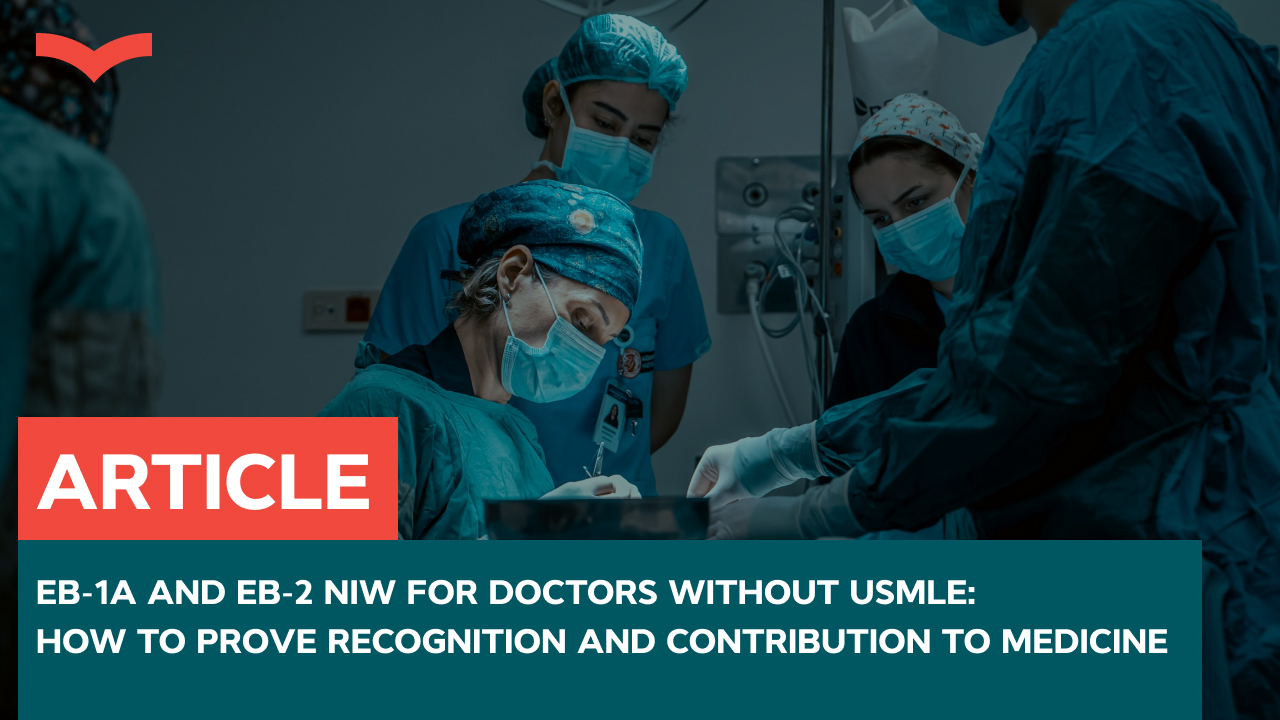
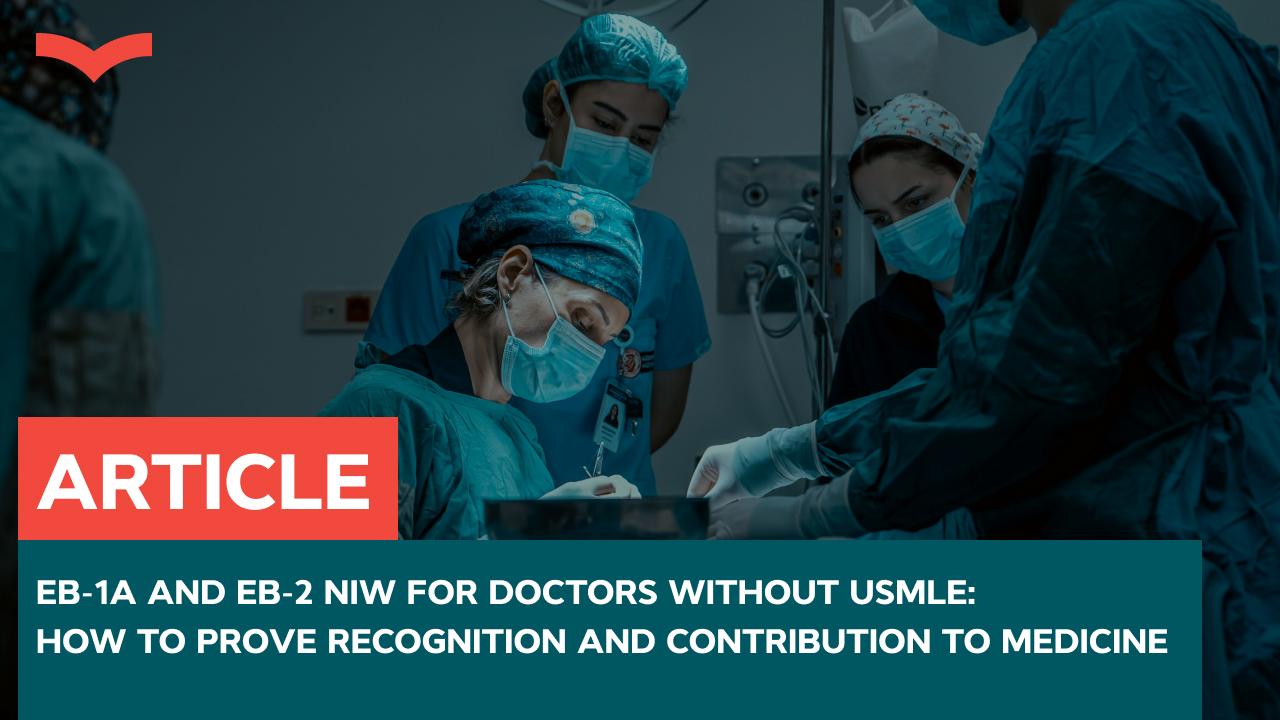
Foreign physicians often delay immigration to the U.S. because they have not yet taken the USMLE – the standardized examinations required for medical licensure. However, filing an immigration petition and obtaining the right to treat patients are two separate processes.
USMLE is not an independent mandatory requirement for an EB-1A or standard EB-2 NIW petition. A physician can pursue these categories before passing the exams if their achievements and professional plan meet the criteria. However, approval of a petition or obtaining a green card does not replace a medical license, nor does it automatically grant the right to practice clinical medicine.

Can you obtain an EB-1A or EB-2 NIW without USMLE?
USCIS evaluates not authorization to treat patients, but the applicant’s achievements or the significance of their proposed work. However, to practice clinical medicine independently, a foreign medical graduate typically must complete certification, pass required exams, satisfy postgraduate training requirements, and obtain a state license. Requirements vary depending on location and position. Without a clinical license, a physician can engage in research, teaching, medical analytics, project management, or public health.
A standard EB-2 NIW should not be confused with the Physician National Interest Waiver (PNIW) special program. The latter requires clinical work for a specified period in a Health Professional Shortage Area (HPSA) or Veterans Affairs facility. Here, we focus on the standard EB-2 NIW, which can be centered around research, medical technology, public health, or clinical developments.
Differences between EB-1A and EB-2 NIW for physicians
In an EB-1A petition, we must establish the physician’s high level of extraordinary recognition. Formally meeting a few criteria is insufficient; the documentation must distinguish the applicant from peers in their field.
In an EB-2 NIW petition, it is necessary to explain why the proposed endeavor has substantial merit and national importance, why the physician is well-positioned to advance the endeavor, and why waiving the job offer requirement benefits the United States.
Simply working in medicine does not guarantee eligibility for EB-2 NIW. Benefits to individual patients or a single employer may not suffice. A broader impact is required: advancing diagnostics and treatment, implementing new technologies, improving patient safety, conducting significant research, or training specialists.
Most often, a strong case is built around one or more of the following profiles:
- A physician-researcher with publications, citations, and scientific projects;
- A leader who has impacted the operations of a department, clinic, or network of institutions;
- A specialist who has developed or implemented an original technique, treatment protocol, or diagnostic program.
Publications: Quality and impact matter more than quantity
Scientific articles are straightforward evidence for a physician, but a simple list of publications rarely demonstrates their true value. We analyze their role in the research, the tier of the journal, independent citations, how other authors use their findings, and the application of results in clinical practice.
Stating “the physician has published 15 articles” conveys only volume. The argument becomes significantly stronger when documents demonstrate that the applicant authored a major portion of the study, independent authors cited their findings, and the proposed approach was adopted in subsequent research, medical guidelines, or clinical practice.
Additionally, leading research projects, participating in multicenter studies, performing peer reviews, and seeing work built upon by independent research groups add substantial weight. For EB-1A, such evidence confirms authorship, peer review, and contributions of major significance. For EB-2 NIW, it demonstrates the track record supporting the proposed endeavor.
There is no fixed target number for publications or citations. A few impactful papers with proven influence are more valuable than dozens of publications rarely cited outside the co-authors’ immediate circle.
Leadership roles: Title alone is not enough
A department head, medical director, program lead, or principal investigator may possess a compelling profile. However, a job title alone does not prove a leading or critical role for EB-1A, nor does it demonstrate the capacity to execute an EB-2 NIW endeavor.
We first substantiate the scale, reputation, and achievements of the organization. Next, we document the physician’s authority and the impact of their decisions using organizational charts, official orders, job responsibilities, reports, and independent expert letters.
The argument is not built on the statement “the applicant managed a department,” but on specific actionable outcomes. For example, the physician established a new specialty area, overhauled diagnostic protocols, implemented complication controls, or trained junior specialists. When documentation demonstrates measurable results, the connection between executive authority and systemic impact becomes far more persuasive.
Impact on treatment protocols and clinical practice
Developing or updating a treatment protocol can be among the strongest forms of evidence. However, having the physician’s name on a committee roster does not automatically prove personal contribution or clinical impact.
We systematically establish:
- What clinical problem existed.
- What solution the applicant proposed.
- Which specific provisions were drafted with their participation.
- Where and on what scale the protocol was implemented.
- How quality, safety, or organizational efficiency improved as a result.
- Whether other institutions adopted the development.
The protocol text itself does not prove the significance of an individual physician’s contribution. Working group records, administrative orders, implementation reports, outcome statistics, training modules, and expert letters detailing the applicant’s exact role may be required.
Adoption beyond a single department carries exceptional weight: usage across multiple clinics, inclusion in national professional guidelines or educational curricula, or independent citations in medical literature.
For EB-1A, this can satisfy original contributions of major significance. For EB-2 NIW, implementation proves the ability to translate ideas into tangible outcomes, establishing a realistic foundation for the U.S. endeavor.

How the same facts serve different categories
The same supporting evidence can strengthen both petitions, but the legal conclusions differ.
| Professional Fact | EB-1A Criteria | EB-2 NIW Criteria |
| Research is cited by independent authors | Work has gained professional recognition | Proposed endeavor builds on findings already valued by peers |
| Physician led a major medical program | Applicant performed a leading or critical role | Track record demonstrates capacity to execute the U.S. endeavor |
| Protocol was implemented across multiple facilities | Physician’s contribution impacted clinical practice | Solution has broader merit and national potential for U.S. application |
Therefore, we do not start by mechanically assigning documents to individual criteria. First, we define the core strategy and overarching narrative, then map how each piece of evidence supports that narrative.
What we consider persuasive evidence
The strongest petitions rely on a cohesive combination of independent sources:
- Documentation of method development and clinical implementation;
- Pre- and post-implementation outcome metrics;
- Publications and data on their practical utilization;
- Official clinical guidelines and recommendations;
- Proof of adoption by outside organizations;
- Official documentation of executive authority;
- Independent expert opinion letters.
Expert letters help contextualize medical facts, but they cannot replace objective documentation. Generic praise like “an outstanding physician” carries far less weight than detailed explanations of the specific methodology, the applicant’s exact role, the scope of implementation, and verified outcomes.
Common mistakes
Even strong experience can appear unconvincing if the physician:
- Relies solely on academic degrees, diplomas, and years of experience;
- Lists publications without demonstrating their real-world impact;
- Treats a leadership job title as self-sufficient proof;
- Claims credit for the achievements of an entire medical team;
- Relies exclusively on peer letters to prove impact;
- Focuses on individual patient outcomes rather than broader systemic benefit;
- Cites national physician shortages instead of articulating an individualized plan;
- Confuses immigration approval with the authorization to practice medicine.
The goal of a petition is not to exaggerate accomplishments, but to distinguish routine duties from achievements that demonstrate recognition, national impact, and the ability to deliver broad benefits.
How we build a physician’s petition
First, the team at Shamayev Business Law defines the applicant’s field of expertise and proposed U.S. endeavor. Next, we align facts with petition criteria, establish the strategy, and map out the evidence structure.
For every achievement, we answer four key questions: what did the physician accomplish, how is their personal role documented, what measurable outcome was achieved, and who can independently verify its significance? We then connect past achievements directly to the U.S. endeavor. Documents, expert letters, and legal arguments must form a single, compelling narrative.

Conclusion
Not having USMLE scores does not close the door to EB-1A or standard EB-2 NIW opportunities. However, approval is granted based on a well-documented professional record, not a medical degree alone.
For EB-1A, proving sustained national or international acclaim and impact is paramount. For EB-2 NIW, demonstrating the national importance of the proposed work and the applicant’s ability to execute it is essential. Publications, leadership roles, and treatment protocols serve as powerful evidence when backed by proof of individual contribution, real-world application, and independent recognition.
If you are considering U.S. immigration as a physician, the Shamayev Business Law team can evaluate your profile, identify the optimal category, and map out which achievements to leverage and which evidence needs strengthening. Complete a free initial case evaluation to receive a preliminary assessment of your options.