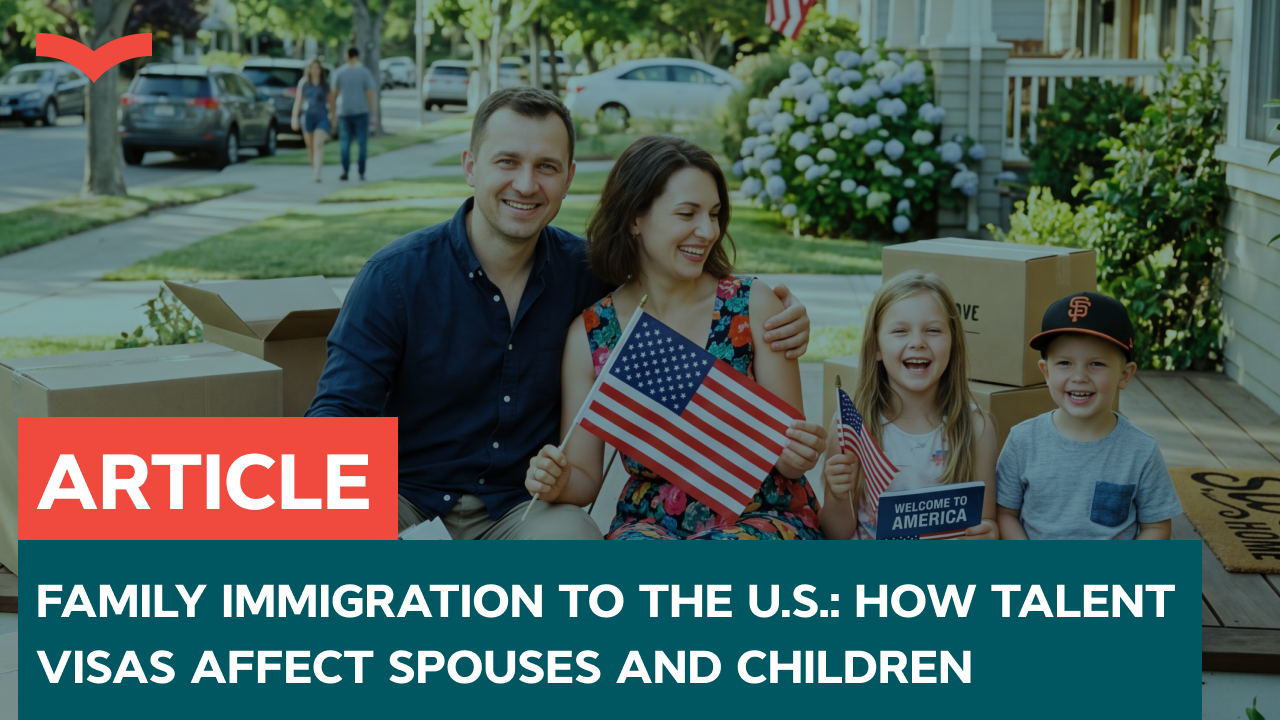
Moving to the U.S. rarely involves just a single applicant. If the primary case is built around a US talent visa, the family almost immediately faces several questions: can the spouse work, where will the children study, is it possible to obtain long-term status, and how to structure the relocation so that it is convenient not only for the main applicant but also for their loved ones.
Many families believe that a U.S. talent visa automatically resolves the relocation issue for all family members. But from a legal standpoint, this is not exactly the case. A family can indeed accompany the primary applicant; however, the scope of rights for family members depends on the specific category. Some statuses provide the opportunity to live and study in the U.S. but restrict the right to work. Others are inherently linked to obtaining permanent status. Therefore, immigrating to the U.S. with a family should always be viewed as a separate immigration strategy, rather than a mere supplement to the primary case.

Why family rights depend on the visa type
What matters is not just the approval of the case, but the specific category under which the applicant applies. This is exactly what determines the status the spouse and children will receive and what rights they will have in the U.S.
If a nonimmigrant visa is issued, such as the O-1, the family receives dependent status. This allows them to move with the primary applicant or join later, but the rights of family members in this case are limited and differ from those of the applicant themselves.
If the case proceeds through immigrant categories (EB-1A or, in some cases, EB-2 NIW), the spouse and children are included in the process as derivative applicants. In this case, it is no longer just about residing in the U.S., but about the opportunity to obtain permanent status and, consequently, a Green Card for the family.
Therefore, the question should be framed not as “can I move with my family,” but as “what status will my spouse and children receive and what rights will it grant them.
What the family receives with an O-1 (O-3 status)
For many applicants, the O-1 is the primary point of entry into the U.S. This is a popular U.S. talent visa for specialists with extraordinary achievements in science, business, education, athletics, the arts, and the motion picture or television industry.
If the primary applicant receives an O-1, their spouse and unmarried children under 21 can generally claim O-3 status. From the perspective of family relocation, this means the family can reside in the U.S. legally alongside the primary applicant. For many, this is already a significant advantage, as there is no need to artificially split the relocation into multiple stages.
However, the scope of rights for family members under O-3 status is limited and differs from the rights of the primary applicant. This primarily affects the spouse.
Under O-3 status, the spouse does not receive an automatic right to work in the U.S. This is one of the key features that cannot be ignored when planning a family move. Therefore, the issue of work authorization for the spouse must be discussed in advance. If it is important for the applicant’s family to have two sources of income immediately after relocating, O-3 status alone is insufficient.
The situation is different for children. They can live in the U.S. with their parents and attend school. From a practical standpoint, this makes the O-1 a viable tool for families who prioritize quickly organizing their children’s education in the U.S. However, it is still important to consider the format of the education, especially if the program involves work in addition to study.
In short, the O-1 picture looks like this:
- Primary applicant: receives the right to work within the scope of the approved petition;
- Spouse and children: can accompany them to the U.S.;
- Spouse under O-3: does not receive the right to work based solely on this status;
- Children: can live in the U.S. and receive an education;
- Dependency: the entire family remains dependent on the primary applicant’s status.
That is why the O-1 should be viewed as a temporary status with specific opportunities and limitations for the family.

Family member rights under immigrant categories EB-1A and EB-2 NIW
While the O-1 is most often used as a temporary status, the EB-1A and, in some cases, the EB-2 NIW are viewed as part of an immigration path toward permanent residency. For a family, this fundamentally changes the legal perspective.
In these cases, the spouse and children of U.S. immigrants can act as derivative applicants. This means they are not merely residing in America alongside the primary applicant but are legally participating in the process of obtaining permanent status within a single immigration track. Consequently, family immigration to the U.S. via talent visas is often structured in several stages – first, relocating on a temporary visa; second, securing status; and finally, applying for an immigrant category.
From a practical standpoint, this is important for several reasons:
- First, it creates the prospect of obtaining a Green Card for the entire family, rather than just a temporary stay status.
- Second, the legal standing of the spouse becomes more stable, particularly once the stage of processing permanent status begins.
- Third, children gain a more predictable, long-term foundation for living and studying in the U.S.
However, it is vital not to oversimplify the requirements. One cannot automatically assume that any O-1 applicant will seamlessly transition to EB-1A or NIW. These are distinct legal categories, and USCIS (U.S. Citizenship and Immigration Services) evaluates their requirements separately. A strong O-1 case does not always guarantee an equally strong case for an immigrant category. Therefore, a sound immigration strategy must be established from the very beginning. Even before filing, it is crucial to understand whether the temporary category is the ultimate goal or merely the first step.
Questions for a family to consider before moving
It is best to begin planning a move by assessing the consequences the chosen route will have for the entire family. This is crucial if the relocation involves a spouse, minor children, or students, or if the spouse expects to start working shortly after arrival.
Before filing any documents, several things should be clarified:
- What status each family member will receive. It is not enough to know only the primary applicant’s category. You must understand exactly what derivative status the spouse and children will receive, for how long, and what restrictions it entails.
- Whether the spouse will be able to work. This question cannot be ignored. Spousal rights in the U.S. depend entirely on the visa category. In some cases, working is impossible without a separate legal basis; in others, the opportunity arises only at the next immigration stage.
- How children’s education will be organized. If a family plans for long-term immigration to the U.S., education must be considered in advance and included in the overall strategy. This concerns not only the choice of school but also the child’s legal status and the possibility of transitioning to other educational formats in the future.
- Whether there are “aging-out” risks for a child. Age is a critical factor for children in immigration cases. If a child is nearing the age of 21, the matter enters a complex legal territory. Timelines must be calculated in advance to build a strategy that prevents the child from losing their derivative status.
Whether a Change of Status within the U.S. is possible. Sometimes it is more convenient for a family to apply for a change of status while inside the country rather than going through consular processing. However, this depends on the specific situation, the family’s current standing in the U.S., and procedural nuances. One should not rely on general advice here without a thorough analysis of documents.
Common mistakes in family immigration via talent visas
In practice, several typical problems can be identified:
- The first mistake is assuming that if the primary applicant is approved, the family automatically receives the same rights. This is incorrect. The legal status of family members almost always grants fewer rights than the status of the primary applicant.
- The second mistake is perceiving the O-1 visa as a complete, long-term solution for the entire family. For some, it is indeed a great starting point. However, if things like spousal work authorization, long-term stability, and a fast track to permanent residency are high priorities, a temporary dependent status might not be sufficient.
- The third mistake is underestimating procedural details. Matters involving documentation, strict deadlines, proof of family ties, the “aging out” of children, and the specific order of filing can all significantly impact the result. In family-related cases, these nuances are particularly sensitive and can make or break a transition.
Relocating a family is a high-stakes puzzle where the pieces don’t always click into place automatically just because the “main talent” is approved. It’s always better to treat the family’s move as a parallel strategy rather than a secondary thought.

Why family issues must be considered before filing
Talent visa categories can indeed be part of a strong family relocation model. However, this only works when the family is considered an independent element of the legal strategy.
From a practical standpoint, the most robust approach looks like this:
- First, the primary applicant’s profile is assessed.
- Next, the derivative opportunities for the family are evaluated.
- Finally, the route to long-term status is mapped out.
This sequence helps avoid the common situation where the main case is already underway, but questions regarding the spouse, children, work, and the family’s future status remain without clear answers.
This is why the applicant’s family should be analyzed from the very beginning. For some families, O-1 will be a convenient first step. For others, it is wiser to immediately build a strategy around an immigrant category and the prospect of permanent residency approval. There is no universal scenario, and promising one is legally incorrect.
If you are considering family immigration to the U.S. via talent visas and want to understand in advance what rights your loved ones will have, it is best to discuss this with a qualified immigration attorney. The specialists at Shamayev Business Law will conduct a free evaluation of the case and evaluate how well the chosen path suits the entire family.