

Business immigration to the United States often looks deceptively simple. It may seem that all you need to do is register a company, invest money, and show an intent to grow the business — and that should be enough to get a visa approved.
In practice, that simplified view is exactly what leads to denials.
The reason is straightforward: USCIS does not look at a business the way an entrepreneur or investor does. It evaluates it as a government agency whose job is to make sure a specific business serves U.S. immigration objectives. That means looking for economic benefit, job creation, real operational activity, and a clearly defined role for the applicant in managing the company.
In this article, we break down which business models USCIS is most likely to approve, which ones tend to work for L-1, EB-1C, E-2, and EB-5, and which ones may look acceptable on paper but fall apart in a real case.
Why Not Every Business Works for Immigration
One of the biggest mistakes applicants make is bringing normal business logic into the immigration process.
In business, efficiency matters: lower costs, automation, remote teams, and operational flexibility. In immigration, those same characteristics can work against the applicant.
For USCIS, a business is not just a source of income for its owner. It is a vehicle that is expected to:
- participate in the U.S. economy;
- create jobs;
- show long-term potential;
- require active management.
That is why a company with no employees, a fully remote setup, or no clear operational structure may be profitable and still be weak for immigration purposes.
A lot of denials come from exactly this gap between a “good business” and a business that actually works in an immigration case.

Why a “Business Visa” Is Not One Single Category
Another common misconception is treating a business visa as a one-size-fits-all solution. In reality, each category serves a different immigration purpose, which means each one places different demands on the business.
L-1 is meant for transferring executives, managers, or specialized employees from a foreign company to a related U.S. company.
EB-1C is the immigrant continuation of the L-1 pathway, with even greater emphasis on executive or managerial capacity and business scale.
E-2 is focused on active investment and the investor’s direct involvement in the day-to-day operation of the business.
EB-5 centers not on management, but on investment and job creation.
The same business model may be a strong fit for E-2 and still not be enough for EB-1C. That is why the strategy should always start with one question: what immigration goal is this business supposed to serve?
How USCIS Actually Evaluates a Business
The formal requirements vary from one visa category to another, but the logic USCIS uses is often very similar. The main issue is not the documents themselves, but what is behind them.
First, they assess whether the business is real. A company has to actually operate, not just exist in registration documents and a business plan.
Second, officers look at operations: processes, contracts, customers, employees, and ongoing business activity.
A separate and important focus is economic benefit. USCIS expects the business not merely to support its owner, but to become part of the U.S. economy. For certain visa categories — especially EB-5 and EB-1C — job creation becomes one of the key factors.
The applicant’s own role matters just as much. If the person is functioning as an ordinary worker or is effectively self-employed, that raises concerns. Immigration logic generally requires a managerial or investment role, not a substitute for the U.S. labor market.
Business Models USCIS Approves Most Often
In practice, there are several types of businesses that tend to show a consistently stronger chance of approval when they are structured properly.
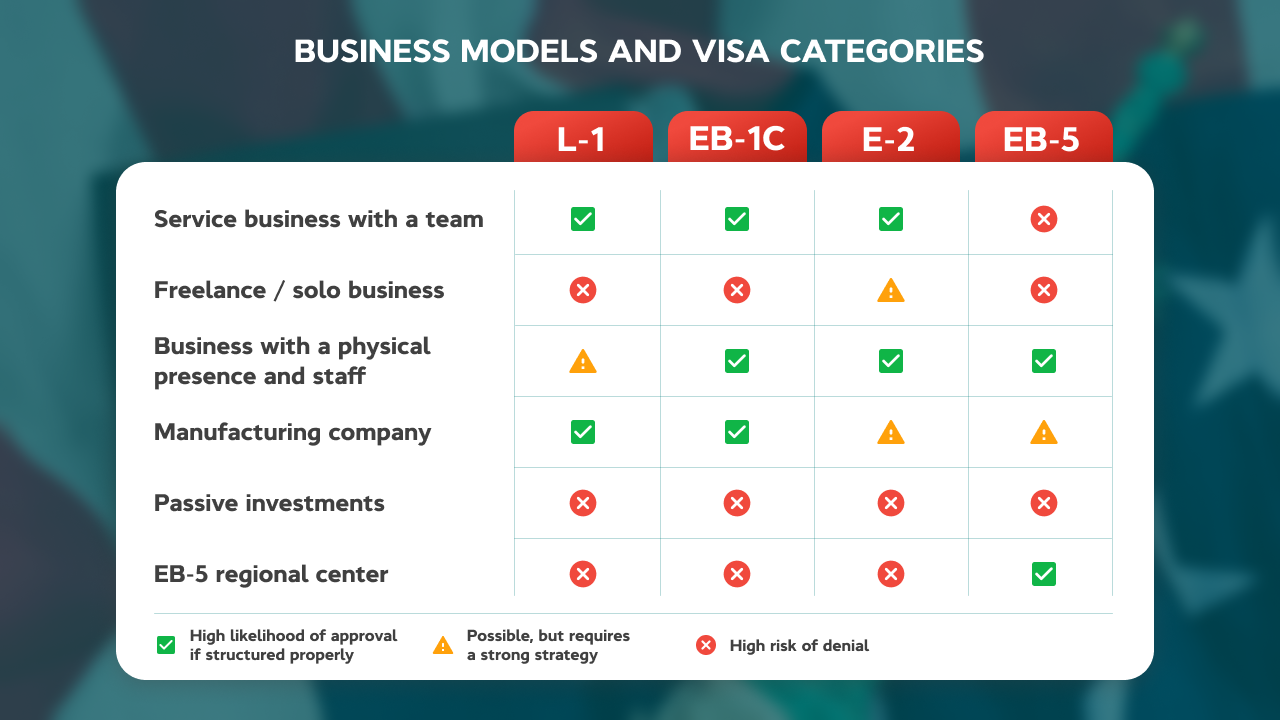
Service Business With a Team
IT companies, consulting firms, marketing agencies, engineering firms, and other professional service businesses are often viewed positively by USCIS as long as they are structured businesses, not just personal practice under a company name.
A team, a clear division of responsibilities, and credible scalability are all critical.
These models often work well for L-1, EB-1C, and E-2, especially when there is a connection to a foreign company or a clearly documented managerial role for the applicant.
Business With a Physical Presence and Staff
Restaurants, logistics businesses, manufacturing operations, education projects, and healthcare businesses are traditionally seen as more tangible. They are easier for USCIS to evaluate because there is a physical presence, staff, and a clear market.
These models work well for E-2, are often suitable for EB-1C, and at a large enough scale may also support EB-5.
Manufacturing and Export-Oriented Companies
Manufacturing and export-oriented businesses are especially attractive from the standpoint of economic benefit. They fit naturally into the idea of expanding an established business across borders and transferring management expertise from one market to another, which makes them strong candidates for L-1 and EB-1C.
Investment Projects for EB-5
For EB-5, the decisive factor is not the type of business itself, but job creation and the correct project structure. Even a large investment will not compensate for the absence of real economic impact.
Comparative Table: Business Models and Visa Categories
Business Models With a Higher Risk of Denial
At the other end are business models that regularly trigger concerns for USCIS. These include companies with no real operations, “visa-driven” businesses with no actual market, fully remote ventures with no U.S. presence, and passive investments.
Formally, some of these may appear to satisfy individual requirements. In practice, however, they often fail the real tests of viability and economic benefit — which leads to RFEs or denials.
Why the Business Plan Matters So Much
For USCIS, a business plan is not a marketing document or an investor presentation. It is a tool for testing the business logic behind the case. An officer looks at how the company will generate revenue, what will drive growth, when employees will be hired, and what role the applicant will play in that process.
Template-based business plans with inflated projections and vague language almost always weaken the case, even when the underlying business might otherwise qualify.
Common Mistakes Applicants Make
In practice, the same problems come up again and again: choosing a visa category without first analyzing the business, underestimating the scale required, failing to build out a team, presenting an unclear source of funds, or trying to structure the case around USCIS requirements instead of the actual business.
Most denials are not really about the visa category itself. They happen because the business was never structured with the immigration goal in mind to begin with.
How to Choose a Business Model That Fits Your Immigration Strategy
Successful cases do not start with company registration. They start with the right questions: which visa are you pursuing, what role are you prepared to play in the business, and which USCIS criteria will matter most in your particular case?
Sometimes that means restructuring the business, scaling it up, or reconsidering the management model. A preliminary expert assessment is almost always less expensive — and far safer — than trying to fix the consequences of a denial later.
Schedule a free review of your immigration case: we will assess your business profile and help determine which visa category is the right fit for you.

Conclusion
USCIS does not approve ideas or paper-only structures. It approves real, operating businesses that bring economic value to the United States and fit logically within the selected immigration category.
There is no universal business model that works for every visa. Strategy is what determines the outcome. When business immigration is approached as a long-term project rather than a formality, the chances of approval become significantly higher.