
In the U.S. immigration system, the “extraordinary ability” category was traditionally associated most frequently with academia, the arts, athletics, and corporate management. However, the rise of the digital economy has shifted the landscape, with professional achievements now increasingly shaped and validated through online platforms such as YouTube, Instagram, TikTok, podcast platforms, and digital media services. As a result, the U.S. talent visa has become accessible to applicants whose professional reputation and influence are built primarily within the digital space.
USCIS (United States Citizenship and Immigration Services) reviews applications from a strictly legal perspective. Decisions are made by immigration officers who verify whether a case meets specific visa requirements and whether the claimed achievements are supported by documentary evidence.
It is important to note that follower counts and view metrics do not automatically guarantee approval. While quantitative data can be submitted as part of the evidence, without an explanation of its significance within a professional field, confirmation from independent sources, or a direct link to specific legal criteria, these metrics are often perceived merely as “popularity” rather than “extraordinary ability.” This is why a successful U.S. talent visa case requires more than just a list of metrics; it requires a documented strategy that identifies which achievements carry legal weight and demonstrates exactly how they are proven to USCIS.

Which bloggers qualify for a talent visa?
The terms “blogger,” “influencer,” and “YouTube creator” describe a format for content production and distribution, rather than a legal professional qualification. For the purposes of “extraordinary ability” and related immigration categories, the critical factor is defining the field of endeavor – the specific professional area in which the applicant has attained achievements and recognition.
In practice, the most successful cases are those where the applicant’s digital activity leads to tangible professional results and recognition within a specific industry. These typically include:
- Educational projects: Training programs, proprietary methodologies, and systematic professional development.
- Business and entrepreneurial sectors: Product development, successful launches, and significant influence over consumer demand and decision-making.
- Technology and product expertise: In-depth reviews, industry analytics, market influence, and the standardization of professional practices.
- Creative industries and media: High-profile projects, strategic collaborations, industry rankings, and prestigious awards.
- Sports, fitness, and wellness: Training methodologies, proven results for students/clients, and recognition from official industry organizations.
From a legal standpoint, it is essential to transition from the concept of “popularity” to the category of “professional significance.” While popularity indicates the size of the audience consuming the content, professional significance demonstrates whether the applicant is recognized as an expert and a leader within their field.
Depending on the applicant’s goals, there are two primary visa strategies to consider:
- The O-1 visa for bloggers (specifically the O-1A category for those in business, education, technology, or entrepreneurship): This is a non-immigrant visa that allows an individual to conduct professional activities in the U.S. under specific projects, contracts, or collaborations.
- The EB-1A visa for influencers: This is an immigrant category designed for obtaining a Green Card. When adjudicating these petitions, USCIS evaluates not only compliance with formal criteria but also the applicant’s overall standing in their professional field, including their level of recognition and status among the top specialists in the industry.
How USCIS evaluates digital achievements
USCIS does not recognize “influencing” as a distinct legal category. When evaluating a petition, the agency verifies whether the evidence provided meets established visa criteria. In digital-focused cases, the applicant’s goal is to demonstrate how digital metrics and commercial results substantiate professional recognition, a leading role, or a significant contribution to their field.
Audience growth and quality
An immigration officer evaluates context and authenticity rather than absolute figures:
- Growth dynamics: Organic metrics and long-term stability.
- Audience geography: International presence and relevance to the U.S. market.
- Audience profile: If the applicant operates in a professional niche, the industry relevance of their followers is critical.
- Signs of sustainability: Evidence of systematic audience attention rather than a single “viral” success.
Key principle: data must support the claim of professional significance and recognition; it should not be an end in itself.
Engagement and retention
Engagement and retention metrics are vital if they demonstrate sustained interest in the content. Average watch time, returning viewers, and engagement loops can serve as proof of the applicant’s professional influence, moving beyond mere technical platform data.

Unique content and original contribution
For talent visas, proving an original contribution is essential. This includes:
- Development of original formats, methodologies, or analytical approaches.
- Systematic research or proprietary frameworks that are cited and utilized by others.
- Establishment of professional standards or practices within a specific niche.
The bottom line: the argument should not be “the audience likes the content,” but rather “the content changed the industry practice, the agenda, or the market,” as confirmed by independent sources.
Market and industry impact
One of the most compelling categories of evidence is impact that can be quantified through external metrics:
- Commercial campaign results: growth in sales, leads, subscriptions, or app installs.
- Influence on consumer choice: measurable effects on product demand and consumer behavior.
- Verified case studies: documentation from brands or platforms identifying the applicant as a key factor in a specific successful outcome.
When utilizing brand data, the documentation must clearly outline the methodology: specifically what was measured, the timeframe involved, and how the direct link between the applicant’s activity and the resulting impact was established.
Commercial contracts and collaborations
Agreements with brands, agencies, or platforms serve as proof that the applicant is in high demand at a professional level. For USCIS, it is crucial that these documents clarify why the company selected this specific creator, the exact role they performed, and the specific results achieved through the collaboration.

Products and launches
Digital entrepreneurs can prove their achievements through their own business performance:
- Products: online courses, subscription models, consulting services, product lines, or SaaS (Software as a Service) platforms.
- Revenue and scale: financial data reflecting the business’s success and growth.
- International reach: evidence of a global footprint or cross-border influence.
- Independent reviews and publications: unbiased feedback and third-party media coverage of the products.
A critical distinction: In these cases, it is vital to differentiate the applicant’s individual contribution from that of their team, as USCIS evaluates the extraordinary achievements of the specific individual rather than the company as a whole.
Educational and expert value
Indicators of professional recognition may include:
- Invitations to speak at professional events and industry conferences.
- Participation in industry forums and specialized panels.
- Expert columns or guest contributions in trade media and specialized publications.
- Involvement in educational projects hosted by well-known platforms.
International audience
International recognition significantly strengthens a visa case when it is thoroughly documented. Such evidence may include:
- Media coverage of the applicant in foreign or international press.
- Contracts and agreements with global corporations and international brands.
- Involvement in projects that have gained recognition or commercial success across multiple countries.
Why “1 million followers” without a strategy is a weak argument
A high follower count does not explain the specific nature of an applicant’s extraordinary ability, nor does it prove that they are among the small percentage of individuals who have risen to the very top of their field.
Without a clear legal framework, these metrics fail to meet USCIS requirements. For a digital creator, the key to success lies in building a coherent case logic: defining a specific professional field, aligning achievements with established visa criteria, substantiating those achievements with documentary evidence, and validating the claims through independent, third-party sources.
How to document a blogger’s achievements
The strength of a case is determined not by the sheer volume of materials, but by their legal relevance and the quality of the sources.
Platform analytics (YouTube Studio, Meta, TikTok analytics)
It is recommended to prepare:
- Data exports covering a relevant period (usually 12–24 months).
- Metrics for growth, retention, and audience geography.
- Verification of authenticity (account access, links to public pages, and, if necessary, notarized explanations).
- An analytical brief where metrics are explicitly linked to specific USCIS criteria.
Income and monetization reports
Suitable sources include:
- Official platform reports (AdSense, Creator tools).
- Bank statements and accounting records.
- Tax documents (if available).
- Confirmations from agencies, multi-channel networks, or management.
Documentation must demonstrate the systematic nature of monetization and, if necessary, benchmark the income against market averages.
Contracts and sponsorships
Evidence may include:
- Agreements and addendums outlining the scope of work performed.
- Proof of actual payments received.
- Letters from companies or brands specifying the applicant’s role and the results achieved.
- Data regarding the scale of the company and the significance of the project.
Media coverage
For USCIS, publications about the applicant are vital, rather than just their own self-published materials. These may include:
- Interviews and profile pieces.
- Industry-specific articles.
- Sector reviews where the applicant is cited as an expert or key opinion leader.
The critical factor is the quality of the source (media outlet status, reach, and editorial independence).
Awards, rankings, and platform statuses
These achievements are considered by USCIS when supported by documentary evidence. You must provide:
- A description of the award criteria and selection process.
- Evidence that the award or ranking is significant to the industry.
- Supporting documents, including certificates, official landing pages, and press releases.

Participation in significant projects
Documents that increase the persuasiveness of the case include:
- Letters from organizations confirming a leading or critical role.
- Project descriptions, including audience reach and final outcomes.
- Evidence that the project is widely recognized within the industry.
Letters of recommendation: selection criteria
Recommendation letters are effective only if:
- The author holds a recognized status in the industry.
- They are competent to evaluate the applicant’s specific contribution.
- The letter contains specifics: projects, measurable impact, results, and comparisons to industry standards.
General letters without factual evidence typically do not strengthen a case.
Differences in O-1 vs. EB-1A requirements for bloggers
There is a fundamental difference in how USCIS approaches these two categories:
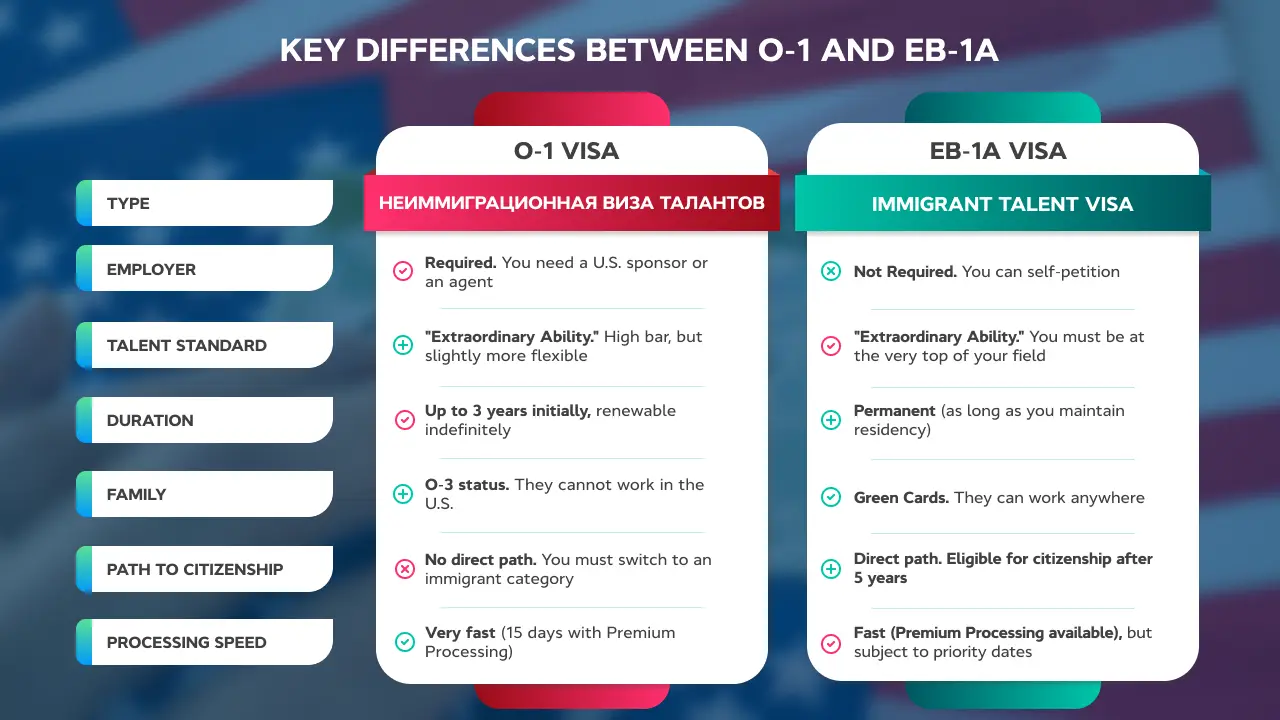
- The O-1 Visa is a temporary, non-immigrant visa. USCIS verifies whether the applicant possesses extraordinary ability and intends to continue their professional activities in the U.S. through specific projects, contracts, or collaborations. The primary focus is on the current level of achievement and its documentary proof.
- The EB-1A Visa is an immigrant category leading to a Green Card. In this case, USCIS evaluates more than just compliance with formal criteria; it assesses the applicant’s overall standing within the professional field. The applicant must prove they are among the top percentage of specialists in their area and that their achievements have sustained and recognized significance.
Common digital strategies
In practice, many digital creators begin with the O-1 visa. This strategy is often used when an applicant already has proven professional recognition, but their evidentiary base for the EB-1A is not yet strong enough. After working in the U.S. under an O-1, the case is often enhanced by additional independent publications, awards, international projects, and further industry recognition, making a subsequent EB-1A petition viable.
There is no “one-size-fits-all” solution; the choice of visa strategy always depends on specific achievements and the quality of existing evidence.
Short-term vs. immigrant strategy
The O-1 is suitable for short-to-medium-term professional plans, allowing one to work legally on projects while building a stronger evidentiary base. The EB-1A is geared toward long-term immigration and requires a higher level of proven achievement at the time of filing.
The risks of self-filing
In digital-focused cases, denials are most often caused not by a lack of achievements, but by errors in legal presentation. Typical issues include:
- Incorrectly defining the applicant’s field of endeavor.
- Selecting visa criteria that are not supported by the actual documentation.
- A lack of independent sources for verification.
- Insufficient explanation of the link between digital metrics and professional recognition.
Critical mistakes made by bloggers
The stage of legal “packaging” of digital achievements is where most applicants make mistakes that significantly lower their chances of approval, even when they possess objectively strong results. Here are the most critical errors that most frequently lead to denials:
- Relying solely on follower counts: applicants often limit their evidence to reach and views without explaining their professional significance. Without independent validation, USCIS views followers as a metric of popularity, not extraordinary ability.
- Lack of case logic: even with strong achievements, a case may be denied if the evidence is not presented as a cohesive system. A common error is failing to create a clear narrative link between the professional field, the selected USCIS criteria, and the provided evidence.
- Weak recommendation letters: generic letters without specific facts, figures, or descriptions of the applicant’s contributions add little value. There is also a risk if the authors lack recognized status in the industry.
- Unverified monetization: claims of commercial success without official platform reports, contracts, or third-party confirmations are not considered reliable. USCIS requires financial results to be documented and comparable to market standards.
- Underestimating the role of an attorney: Filing without a professional legal assessment often leads to the wrong choice of criteria and poor “packaging” of data. The primary challenge is not just gathering data, but translating digital metrics into the specific legal language required by USCIS.
How to build a strong case as a blogger
It is best to start preparation in advance, as a significant portion of the evidence requires considerable time to secure: obtaining formal letters from brands, coordinating media publications, collecting analytics reports, and building the overall evidentiary structure.
An effective preparation model consists of the following steps:
- Define your professional field and positioning.
- Select criteria supported by reliable sources.
- Gather evidence for each criterion.
- Prepare an explanatory narrative: metrics must be interpreted within a professional context and validated by independent materials.
If the evidence package lacks independent confirmation or fails to demonstrate sustained recognition, it is advisable to change the strategy. This might involve strengthening external sources, identifying more influential recommenders, or gathering deeper proof regarding campaign results and the applicant’s specific contributions.

The importance of preliminary evaluation
A preliminary legal analysis is vital to determine:
- Whether the applicant qualifies for the O-1 visa for bloggers at their current stage.
- Whether it is practical to pursue an EB-1A visa strategy for influencers.
- Which pieces of evidence are legally robust for USCIS and which have limited value and require reinforcement.
Here is the professional English translation for the conclusion of your article:
Conclusion
Blogging and digital content creation have evolved into full-fledged professional activities. Their outcomes can satisfy the criteria for U.S. talent visas, provided they are documented and reflect sustained recognition within a professional field. The specific format of the work is secondary; the primary factors remain the level of achievement and its legal interpretation.
For applicants pursuing immigration as influencers, the defining factor is not the size of their audience, but the chosen strategy and the quality of their evidentiary base. Digital metrics gain value only when they are logically linked to visa criteria and substantiated by independent sources. This structured approach is what minimizes the risk of denial and helps avoid common filing mistakes.
A personalized preliminary case evaluation allows for the identification of an optimal visa strategy and helps distinguish between evidence that is legally fit for USCIS and evidence that requires enhancement. This approach ensures that a petition is built intentionally and aligned with long-term objectives.
Shamayev Business Law provides a free evaluation of digital cases and assists in developing a strategy for U.S. talent visas, including the O-1 and EB-1A categories for YouTube creators and influencers. We take USCIS requirements into account and build strategies based on actual achievements and their legal significance, rather than merely formal metrics.