
For business owners, choosing a U.S. visa is a strategic decision rather than picking the option that seems easiest to get. The wrong choice can lead not only to a denial, but also to years of lost time, unnecessary spending, and missed immigration opportunities.
In most cases, entrepreneurs end up choosing between three options: L-1, E-2, and EB-1C. All three are often discussed under the umbrella of business immigration, but they serve very different purposes. Each one fits a different business model, ownership structure, and long-term plan.
In this article, we break down when each option makes sense, how business structure affects visa strategy, and why there is no one-size-fits-all answer.
Why You Should Not Choose a Visa Based on Name Recognition
A common mistake looks like this: a business owner hears that a certain visa is “good for entrepreneurs” and starts trying to shape the business around that category. That is usually where the problems start.
USCIS does not focus on what you hope to do in theory. It looks at whether your business actually fits the legal requirements of the visa category. When the visa does not match the real structure of the company, the case can look forced or artificial — even when the paperwork is otherwise strong.
The better approach is to work backward:
- analyze the business structure;
- define the owner’s actual role;
- clarify the long-term goal, whether that means temporary status or a green card;
- choose the immigration strategy based on those factors.
That sequence matters more than many applicants realize.
The Core Difference Between L-1, E-2, and EB-1C
These options are often grouped together, but they are built on very different legal frameworks.
L-1 is based on an international business relationship and a qualifying executive or managerial role.
E-2 is built around investment and active involvement in running the business.
EB-1C is an immigrant category for executives and managers seeking permanent residence through a qualifying company.
Understanding that difference is the starting point for making the right choice.

L-1: Best for an Existing International Business
The L-1 is often the strongest option for business owners who already operate a real company outside the United States and want to open, expand, or manage a related U.S. office.
When L-1 Makes Sense
L-1 may be a strong fit when:
- the foreign company is actively operating and has employees;
- there is a qualifying relationship between the foreign and U.S. companies (parent, subsidiary, or branch);
- the applicant has held a managerial or executive position for at least 1 year within the past 3 years;
- in the United States, the applicant will perform a managerial role with the ability to delegate operational tasks to subordinates.
This option can work especially well for entrepreneurs who do not want to rely primarily on a large upfront investment and can show a genuine business structure, operational growth, and a real need for executive leadership in the U.S.
L-1 Limitations
That said, L-1 has important limitations:
- It is a temporary visa;
- It depends on maintaining the foreign business relationship;
- It can become a weak case if the owner is doing everything personally instead of functioning in a true managerial or executive role.
In other words, L-1 works best when the business already looks like a real cross-border company — not a solo operation trying to fit into the category.
E-2: Best for Active Investors Building a U.S. Business
E-2 works best when:
- the applicant is a citizen of a treaty country with the United States;
- the investment has already been committed to the business and is fully at risk;
- the source of the investment funds is fully transparent and lawful;
- the investment is substantial for the type of business, though there is no fixed minimum;
- the applicant personally directs and develops the business in the United States;
E-2 is often chosen by entrepreneurs who want to move quickly, test the market, and avoid building a more complex international structure right away.
E-2 Limitations
At the same time, E-2:
- does not lead directly to a green card;
- requires ongoing renewals;
- becomes vulnerable if the business loses momentum.
EB-1C: Best When the Goal Is a Green Card
EB-1C is not just another visa option but an immigration strategy. It fits business owners who see the U.S. business as a long-term project from the start.
When EB-1C Makes Sense
EB-1C is a logical choice when:
- there is a qualifying relationship between the foreign and U.S. companies;
- the U.S. company has been doing business in the United States for at least one year;
- the applicant has worked outside the United States for at least one year within the relevant three-year period;
- the applicant has held and will hold a managerial or executive position;
- the primary goal is permanent residence rather than temporary status.
In practice, EB-1C often becomes the next step after L-1, but in some cases it can also be a standalone strategy if the business structure is strong enough.
EB-1C Limitations
This category requires:
- a higher level of evidence;
- a stable management hierarchy;
- time for the U.S. business to develop.
How Business Structure Should Drive the Visa Decision
The right visa strategy usually depends on a few core questions:
- Do you have an active company outside the United States?
- Who handles the operational work in the business?
- Are you prepared to invest substantial funds?
- Is a green card part of your medium-term goal?
In most cases, it is the mismatch between these factors and the chosen visa category that leads to denials.
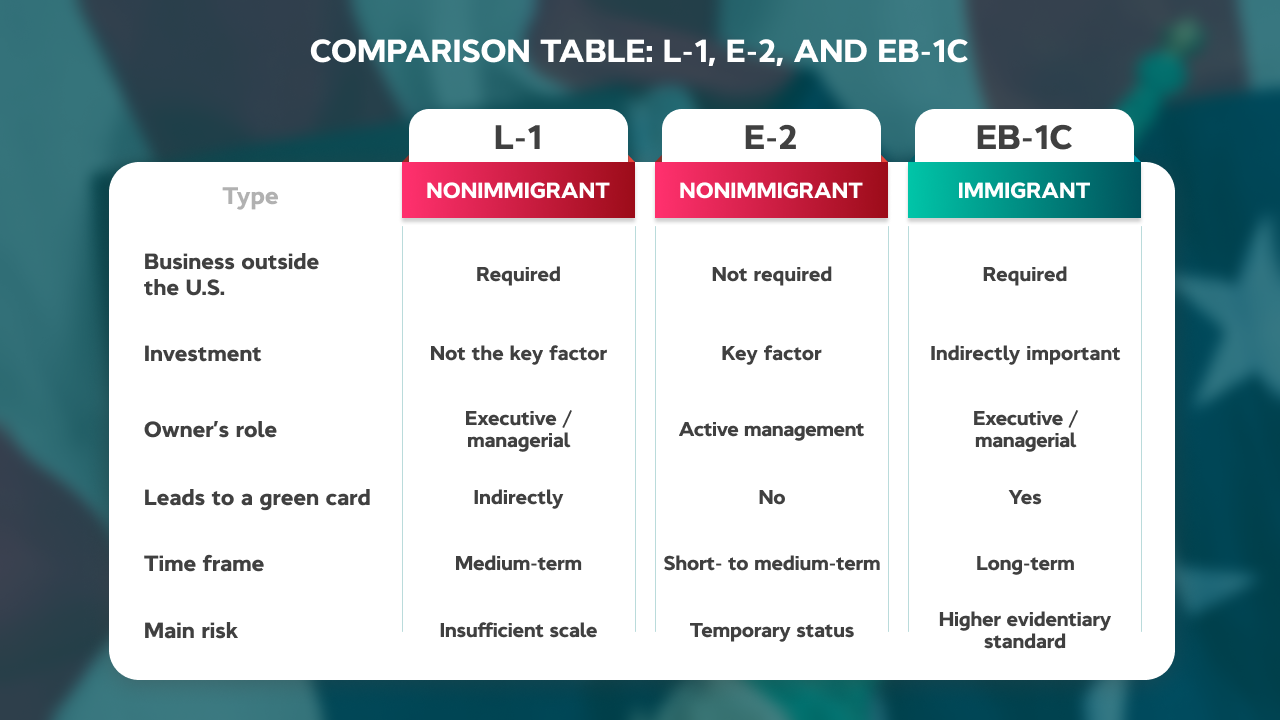
Comparison Table: L-1, E-2, and EB-1C
Common Mistakes When Choosing a Visa
In practice, the same mistakes come up again and again:
- choosing E-2 despite having a strong international business where L-1 would make more sense;
- trying to file EB-1C without a genuinely managerial level;
- using L-1 for a business with no real foreign operations;
- focusing only on speed instead of strategy.
It is important to understand that a visa category can be changed. Lost time and denials cannot.
How to Choose the Right Visa for Your Goals
The right choice always starts with an honest analysis:
- where your business stands today;
- what role you are realistically prepared to perform;
- what status you want to have in two to five years.
Sometimes the best strategy looks like this:
E-2 → growth → L-1 or EB-1C
Sometimes it is better to start with L-1 and build toward EB-1C.
And sometimes E-2 turns into a dead-end if the real goal is a green card. To avoid wasting time on dead-end strategies, it is important to objectively assess how each visa category fits your case. Book a free immigration case evaluation. Within 2 business days, we will review your profile and help determine objectively which path is the most direct route to your goal.
Conclusion
L-1, E-2, and EB-1C are not competing visas. They are tools designed for different goals. Which one makes sense depends on the business, the owner’s role, and the long-term goal. There is no universal best option.
For a business owner, the key to success is not filing speed or the visa label. It is a strategy built around the real facts of the case. That is what helps avoid denials and use business immigration as a stable path rather than a risky one.