The year 2026 has seen a significant spike in interest regarding US immigration through “extraordinary ability” categories. These pathways are attracting top-tier professionals from diverse fields, including tech, science, entrepreneurship, the creative arts, and athletics.
While traditional immigration routes – such as employer-sponsored visas, academic or investment programs – remain available, the tide is shifting. Today’s specialists are more inclined toward achievement-based categories that prioritize their individual professional milestones.
What makes the O-1, EB-1A, and EB-2 NIW visas so compelling? Essentially, they allow you to build a relocation strategy centered on your own expertise, career trajectory, and industry recognition. It’s a path for those who want their professional merit to be their primary ticket to the U.S.
However, the landscape is evolving. In 2026, USCIS expectations regarding the quality of evidence are higher than ever. The bar for “extraordinary” or “exceptional” continues to rise, requiring more sophisticated documentation.
What does the US talent visa application look like in 2026? What specific nuances should you keep in mind if you’re eyeing a long-term career in the States right now? How can you craft a petition that truly resonates with USCIS officers? We will explore these critical questions and more in this article.
Decoding “Talent Visas”: What are they and why do they stand out?
“Talent visas” is an umbrella term used to describe U.S. visa categories tailored specifically for individuals with extraordinary skills and a proven track record of success. This group primarily consists of the non-immigrant O-1 visa and the immigrant EB-1A and EB-2 NIW categories, all of which reward professional excellence with a direct route to living and working in the United States.
The O-1 visa: extraordinary ability talent visa
The O-1 classification serves as a specialized non-immigrant pathway for professionals who have reached the pinnacle of their respective fields. It is designed for high achievers spanning academia, commerce, athletics, and the creative arts.
To streamline the application process, this category is divided into two primary tracks:
O-1A: Tailored for experts in science, technology, education, business, and sports.
O-1B: Reserved for distinguished individuals in the arts, motion pictures, and the television industry.
A typical O-1 candidate is someone whose reputation is backed by significant national or international acclaim. This might manifest as a researcher with pioneering publications, a tech visionary leading high-impact projects, a decorated professional athlete, or an award-winning director.
The critical distinction to remember is that USCIS does not evaluate “talent” as an abstract concept. Instead, the focus is on verifiable milestones and the measurable influence a professional has exerted on their industry. In the 2026 landscape, the strength of your petition lies in the objective evidence of your career’s impact.
Key requirements for the O-1 talent visa
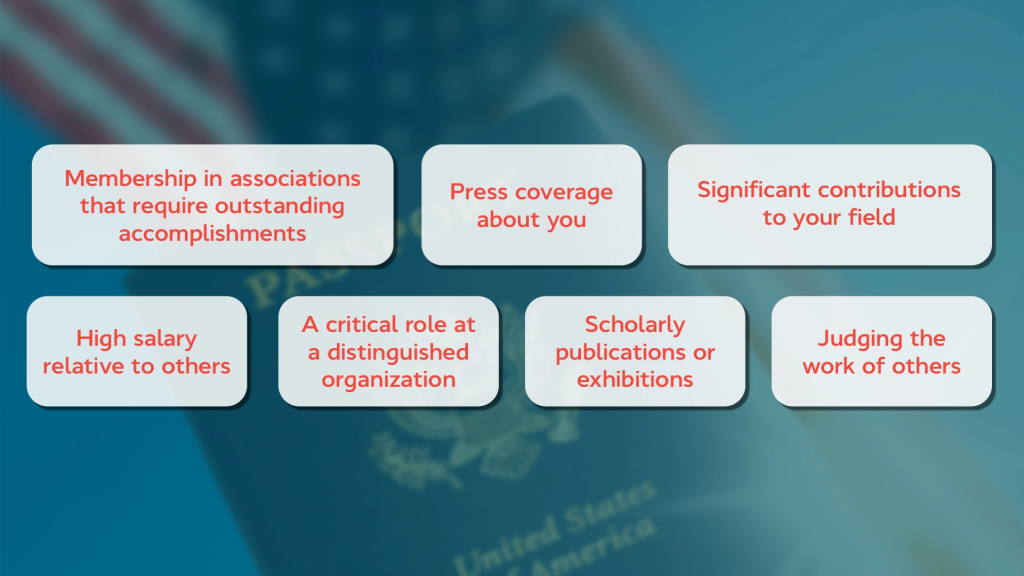
USCIS looks for solid, factual evidence that you are recognized in your field. To qualify, an applicant typically needs to meet at least three of the following criteria:
- Major awards or prizes: This involves securing national or international prizes for excellence. We’re talking about high-level recognition – think major industry awards, festival trophies, or prestigious grants that signify you are at the top of your game.
- Membership in associations that require outstanding accomplishments: You must belong to associations that require outstanding achievements for admission. If anyone can join by paying a fee, it won’t count.
- Press coverage about you: This refers to published material about you and your work in major professional journals, trade publications, or high-traffic mainstream media. The content must focus on your professional achievements.
- Significant contributions to your field: This is the “innovator” category. You need to prove you’ve made a scientific, scholarly, or business-related contribution that fundamentally moved the needle in your industry. This is usually evidenced by patents, proprietary technologies, or unique methodologies adopted by others.
- High salary relative to others: If your salary or service fee is significantly higher than the industry average, it serves as a “market-based” proof of your value. This is a purely quantitative way to show that your expertise is in high demand.
- A critical role at a distinguished organization: This applies if you have performed a lead or critical role for an organization with a distinguished reputation. You must demonstrate that your specific contribution was vital to the success of a high-stakes project or the company’s overall standing.
- Scholarly publications or exhibitions: For the “thinkers” and “researchers,” this involves authoring scholarly articles in professional journals or other major media. In 2026, USCIS looks closely at citation counts and the reputation of the databases (like Scopus or specialized industry archives) where your work is indexed.
- Judging the work of others: Have you sat in the judge’s chair? This criterion is met if you have evaluated the work of others in your field. Examples include serving on a jury for a major competition, acting as a peer reviewer for scientific journals, or participating in a technical thesis defense panel.
For the O-1B category, which covers arts and entertainment, the rules are similar, but the focus is on your creative track record. USCIS looks for things like your role in well-known projects, good reviews or articles about you, and whether your work was a commercial success.
We’ve been working in the U.S. immigration market for over 11 years and have handled more than 4,200 successful cases. From our experience, it’s risky to just do the bare minimum. While the law requires three criteria, we usually recommend aiming for five or more. This makes your petition much stronger and helps you avoid getting a “Request for Evidence” (RFE), which can slow everything down.
Recently, USCIS has shifted its focus. They aren’t just checking boxes anymore; they are looking at the actual impact of your work. If you only provide the minimum proof, your success depends heavily on how the officer interprets your story. The more solid, high-quality evidence you include, the better your chances of a quick approval.

Securing immigrant visas in 2026
Starting January 21, 2026, the U.S. Department of State implemented a temporary pause on immigrant visa approvals for citizens of 75 different nations. This suspension affects various countries across South America, Asia, Africa, and parts of Europe.
This new policy only applies to immigrant visa categories – specifically EB-1A and EB-2 NIW – for applicants who are currently outside the United States.
Here is what you need to know about your options now:
The O-1 visa remains available: Since the O-1 is a non-immigrant visa, it is not affected by this suspension. You can still apply for it from abroad.
Adjustment of Status (AOS): You can still obtain an EB-1A or EB-2 NIW visa if you are already physically present in the U.S. on a different legal visa. This process allows you to switch your status to a Green Card without having to leave the country.
In short, while the path for those applying from overseas has become more restricted for certain categories, there are still reliable ways to secure your future in the U.S. through non-immigrant entries or internal status changes.

EB-1A: extraordinary ability visa that leads to green card
The EB-1A category is an immigrant visa designed for people with extraordinary ability and leads directly to a U.S. green card. It belongs to the first preference employment-based immigration category and gives permanent residence to the main applicant and their immediate family members if approved.
One of the main advantages of EB-1A is the ability to apply without a U.S. employer. Applicants can self-petition and prove their professional achievements independently, which makes this category attractive for highly accomplished specialists who want more career flexibility in the United States.
EB-1A is commonly used by scientists, researchers, artists, entrepreneurs, athletes, and business professionals who have reached a high level of recognition in their field and can document strong, measurable achievements.
Qualifying criteria for EB-1
While the EB-1 requirements share a similar structure with the O-1 visa, the expectations are significantly higher. Legally, you must meet at least 3 out of 10 specific criteria. Many of these overlap with the O-1, such as awards, professional memberships, media coverage, judging experience, original contributions, scholarly articles, leading roles in prestigious organizations, and high pay.
For experts in science, business, or athletics, these eight criteria are the standard. However, those in the arts have two additional options to prove their standing:
- Artistic displays: Evidence of your work being shown at exhibitions, showcases, or galleries.
- Commercial Success: Proven track record in the performing arts or entertainment industry, shown through box office receipts, record sales, high ratings, or similar data.
On paper, the thresholds look the same, but in practice, the evidence for an EB-1A must be much stronger. While a national-level award might be enough for an O-1, the EB-1A often requires international recognition or a major impact on the industry as a whole.
Officers don’t just check if you have three items on your list; they use a three-step evaluation process to decide if you truly belong at the top of your field:
- The objective review: First, they verify that you technically met the required number of criteria and that your documents are authentic.
- The subjective review (Final Merits Determination): This is where they look at the quality. They analyze the prestige of your awards, the reputation of the media outlets that wrote about you, and the actual influence of your professional contributions.
- The future value test: Finally, they consider how you plan to continue your work in the U.S. and what kind of benefit your presence will bring to the country.
Even if you check three boxes, an officer can still deny the petition if the overall “story” of your career doesn’t feel strong enough. This is why we always aim to present more than the minimum three criteria, backing each one with the most powerful evidence possible.

EB-2 National Interest Waiver (NIW): smart path to a green card
Not every strong professional has international awards or global fame. In many cases, the main value comes from the importance of the work itself and how it can benefit the United States. The EB-2 National Interest Waiver is an employment-based green card category created for professionals whose work is considered important for the country. This category is widely used by researchers, engineers, entrepreneurs, and other specialists whose projects have broad practical or economic impact.
EB-2 NIW requirements
To qualify for the EB-2 category, you generally need to prove your educational background and professional track record. Most applicants hold a Master’s degree or higher.
Alternatively, you can qualify with a Bachelor’s degree if you have at least five years of experience in your field, showing a steady increase in responsibility. If you don’t have these specific degrees, there is another path for those with “Exceptional Ability.” This is a legal term that requires meeting at least three of the following six benchmarks:
- A degree or diploma related to your professional field.
- At least 10 years of full-time experience in your occupation.
- A professional license or certificate (if required for your job).
- A salary that is significantly higher than the market average.
- Membership in professional associations.
- Official awards or recognition for your work.
Most EB-2 NIW applicants have strong academic backgrounds. We frequently see researchers, engineers, doctors, entrepreneurs, and IT specialists successful in this category.
The second part of the requirement is the “National Interest”. Usually, EB-2 visas require a U.S. employer to sponsor you and go through a process called PERM, where they must prove there are no qualified Americans available for the job. With the EB-2 NIW, you can skip the employer requirement and petition for yourself. To do this, you must prove that your work is so beneficial to the United States that the government should waive the standard labor certification.
Your proposed project must have “Substantial Merit” and “National Importance.” Substantial merit means your work provides a real benefit – whether scientific, economic, or cultural. National Importance means the impact of your work reaches across the whole country. For example, developing a new medical treatment has national importance, whereas opening a small local shop does not. Your work should affect the industry at large, touch on government priorities, or have a nationwide reach.
Finally, you must show that you are “well-positioned” to succeed. USCIS will look at your entire career – your degrees, years of work, patents, publications, and past collaborations with well-known organizations – to decide if you have the skills to actually lead your proposed project.

FAQ
Question: What is the total cost of obtaining a “Talent Visa” in 2026?
Answer: Your total investment is divided into two main parts: mandatory government filing fees and the cost of professional case preparation.
- Government Fees: As of March 2026, the base cost for filing a petition with USCIS typically averages around $2,000. This covers the primary forms and the required Asylum Program fee. If you need a decision quickly, you can opt for Premium Processing. As of March 1, 2026, this fee has increased to $2,965, which guarantees a response from USCIS within 15 to 45 days, depending on your specific visa category.
- Professional Services: While you can technically prepare a petition on your own, the “DIY” route requires an enormous amount of time and a deep dive into complex legal nuances. In reality, self-filed cases often face higher rejection rates or grueling Requests for Evidence (RFEs). Many applicants find themselves turning to experts after months of trial and error. At Shamayev Business Law, our legal service fees for talent visas start at several thousand dollars, depending on the complexity of your background and your level of involvement in the process.
Think of these costs as a strategic investment in your future and your residency in the world’s most powerful economy. A professional approach protects your timeline and significantly boosts your probability of success.
Start with a free evaluation. We offer an initial assessment of your profile at no risk to you. You will receive a clear, honest answer regarding your chances for a talent visa in 2026 and specific advice on which criteria you should focus on right now.
Question: Can I get an O-1 visa without a U.S. employer?
Answer: Not directly. You cannot sponsor yourself for an O-1 visa; the petition must be filed by a U.S.-based employer or a designated agent acting on your behalf.
Question: What are the key differences between an O-1 visa and an EB-1A Green Card?
The primary distinctions between the O-1 visa and the EB-1A Green Card lie in the legal status they provide and the difficulty of the application process. The O-1 is a non-immigrant category, which serves as a temporary work permit, whereas the EB-1A is an immigrant category that leads directly to permanent residency.
Another major difference is that the O-1 requires a U.S. employer or agent to sponsor the petition, while the EB-1A allows you to self-petition without any job offer. Generally, the O-1 is considered slightly more accessible; you must demonstrate national-level recognition by meeting 3 out of 8 criteria, with a standard that is slightly lower than the EB-1A.
In contrast, the EB-1A is reserved for those with international-scale achievements or those who can satisfy 3 out of 10 more rigorous criteria. Because of these differences, many professionals use the O-1 as a tactical first step to enter the country and later transition to an EB-1A through the Adjustment of Status.
Question: Is it better to choose the EB-1A or the EB-2 NIW?
Answer: It depends on your background. Choose the EB-1A if you have “famous” achievements, like big awards, lots of media coverage, or high-level leadership roles. Choose the EB-2 NIW if you are a highly skilled professional with a project that is very useful for the U.S., even if you don’t have many personal trophies.
Simply put, the EB-1A is about your fame and status, while the EB-2 NIW is about the value of your work to the country. Both lead to a Green Card and don’t need a job offer. However, in 2026, the EB-2 NIW can be harder to get because it is more subjective, it’s up to the officer to decide if your work is “important enough”, whereas the EB-1A relies more on clear facts and documents.